



In this
issue

WELCOME
NURSING SCIENCE


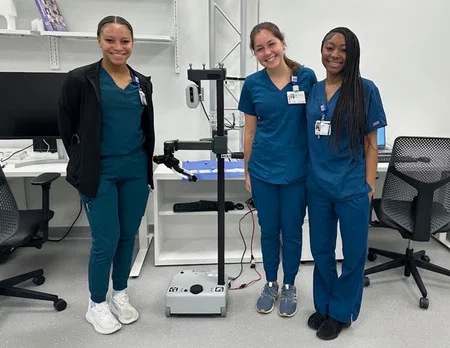
Robotic Tutor for Nursing
AI's Role in Nursing
Assessing the Knowledge and Attitudes of Registered Nurses About Artificial Intelligence in Nursing and Health Care
EDUCATION
PRACTICE
The Day in a Life of a Virtual Nurse and a Bedside Nurse
Enhancing Nursing Efficiency and Satisfaction with Smart Room Technology
PROFESSIONAL DEVELOPMENT
My Journey in Nursing: Into the Virtually Unknown
Engineered for Care: How Former Engineers Are Innovating Nursing
MAGNET
FROM OUR TEAMS
ABOUT DISCOVERN


© 2024. Houston Methodist, Houston, TX. All rights reserved.
NURSING SCIENCE
Assessing the Knowledge and Attitudes of Registered Nurses About Artificial Intelligence in Nursing and Health Care
Article Review by Teresa Sparks, PhD, JD, MSN, RN
Article Review by Teresa Sparks, PhD, JD, MSN, RN

Title:
Assessing the Knowledge and Attitudes of Registered Nurses About Artificial Intelligence in Nursing and Health CarePublished: May/June 2021
Level of Evidence: Level C
What was the purpose of the study?
Evaluate the knowledge and attitudes of Registered Nurses (RNs) about Artificial Intelligence (AI) in nursing and health care.
What was the population?
RNs in practice and/or education.
Was the setting comparable to Houston Methodist? Did the nurses in the study share characteristics similar to those of the nurses at Houston Methodist?
The study participants were RNs who responded to a nationally distributed broadcast email inviting them to participate in an online survey. A total of 675 RNs responded, with an equal number representing practice and education. Of the respondents in practice, 40% practiced in ambulatory care and 30% practiced in an acute care setting.
The respondents identified as White (80%), Black or African American (10%), and Asian (5%), with more than 50% over 50 years of age and 90% female. Forty percent had a bachelor’s degree, 35% had a master’s degree, 21% had a doctoral degree, and 5% had earned an associate degree or nursing diploma.
What were the methods used in the study?
A prospective survey design was utilized to survey practicing RNs across the United States using a 53-item survey. Survey items included demographic information, education, practice setting and position, current use of AI in daily life, knowledge about and attitudes about the use of AI in nursing and health care, potential uses for AI in nursing, and competencies in AI needed by practicing nurses, nursing students and nursing faculty.
What were the findings?
AI Knowledge
Practical Application of AI
Attitudes Related to AI
- 72% identified as being tech savvy
- Approximately 70% heard of AI in healthcare
- 30% reported knowledge of how AI is used in nursing practice
- Greater than 70% knew of speech-text recognition, spam filters, and algorithms for media
- Over 74% agreed or strongly agreed that AI would be helpful for detection of signs and symptoms, assessing social determinants of health, care coordination interventions, transition management interventions, intervention indication, developing a problem list, and documentation of care
- Less than 60% agreed or strongly agreed that automated diagnosis(ses) and physical exam notification would be useful
- Over 80% agreed or strongly agreed that automated screening for depression, social support, health behaviors, risks, and the like would be useful
- Approximately 70% agreed or strongly agreed AI would revolutionize nursing and healthcare
- 5% agreed or strongly agreed AI would replace human RNs in the future
- 10% agreed or strongly agreed AI would replace interprofessional team members in the future
- 20% reported being frightened by AI
- 70% agreed or strongly agreed AI should be part of nursing education
- 80% agreed or strongly agreed that AI should be part of professional development
- 70% reported nursing faculty should possess competency in AI
Do the study findings make sense?
Knowledge of the geographical location of the study respondents would assist with context. However, as a whole, yes, the findings make sense.
What changed as a result of this study?
Nothing related to the study resulted in a change.
Why is this study important for nursing?
Gaining insight into the knowledge, practical application and attitudes of AI from the perspective of practicing RNs can guide and direct future AI developments in nursing and health care and how AI is operationalized in practice.
Reference: