© 2026. Houston Methodist, Houston, TX. All rights reserved.





In this
issue

WELCOME
NURSING SCIENCE


Article Review: A Randomized Controlled Trial of Artificial Intelligence-Based Analytics for Clinical Deterioration
The Impact of AI Recommendation on Diagnostic Accuracy in Clinical Decision Making
EDUCATION
Embracing Artificial Intelligence in Nursing Without Losing Our Humanity
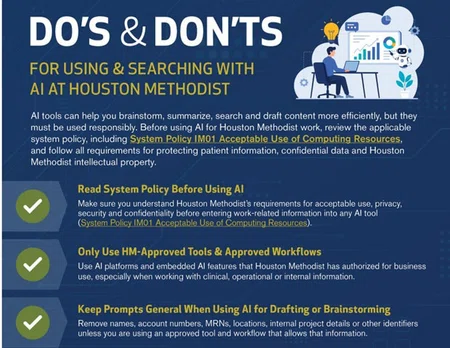
Do's and Don'ts for Using and Searching with AI at Houston Methodist
PRACTICE
CNREP Pilots Innovative Wound Care Copilot to Enhance Pressure Injury Assessment
Text-SAFE: A Digital Health Approach to Improving Follow-Up Care and Support After Sexual Assault
PROFESSIONAL DEVELOPMENT
Artificial Intelligence Education
Clinical Informatics Council: Empowering Nurses Through Technology
From Bedside to Informatics
MAGNET
FROM OUR TEAMS
ABOUT DISCOVERN


PRACTICE
CNREP Pilots Innovative Wound Care Copilot to Enhance Pressure Injury Assessment
By Kimaya Barnes, MHA, MSN, RN, NE-BC, NPD-BC, CVRN-BC – Manager – Houston Methodist Hospital

The Center for Nursing Research, Education and Practice (CNREP) continues to advance innovation in nursing practice through the successful pilot of a nurse-led Wound Care Copilot service that combines clinical expertise, standardized assessment and emerging technology. The initiative was designed to provide an additional layer of clinical support for bedside nurses by leveraging the expertise of specially trained wound care registered nurses serving as copilots.
These wound care-trained nurses underwent additional training to standardize pressure injury assessment, documentation review and staging practices. Acting as clinical consultants, they reviewed wound documentation and images, collaborated with bedside nurses and supported accurate staging of pressure injuries in accordance with National Pressure Injury Advisory Panel (NPIAP) guidelines. The goal was not to replace the bedside nurse's assessment but rather to provide expert guidance, promote consistency in staging and strengthen documentation quality.
During the 25-day pilot conducted on Main 8, a medical-surgical unit, and the Medical Intensive Care Unit (MICU) at Houston Methodist Hospital in the Texas Medical Center, the Wound Care Copilot team completed 66 consultations, including 32 pressure injury reviews. The pilot identified documentation gaps, improved staging consistency and provided an additional level of expert clinical review for complex cases.
The success of the pilot has created opportunities to extend nursing expertise beyond the bedside through artificial intelligence (AI)-supported innovation. CNREP has partnered with the University of Houston to support the development of an AI-driven robotic platform that captures standardized wound images and assists clinicians with pressure injury staging. Findings from the Wound Care Copilot pilot are helping inform the development and validation of this technology, ensuring future AI models are grounded in expert nursing assessment and evidence-based practice.
This collaboration exemplifies CNREP's commitment to integrating nursing expertise, education, research and emerging technology to improve patient care. By investing in innovative models that support frontline clinicians and explore the future of AI-assisted wound assessment, CNREP continues to advance patient safety, improve documentation quality and strengthen nursing practice.