© 2026. Houston Methodist, Houston, TX. All rights reserved.





In this
issue

WELCOME
NURSING SCIENCE


Article Review: A Randomized Controlled Trial of Artificial Intelligence-Based Analytics for Clinical Deterioration
The Impact of AI Recommendation on Diagnostic Accuracy in Clinical Decision Making
EDUCATION
Embracing Artificial Intelligence in Nursing Without Losing Our Humanity
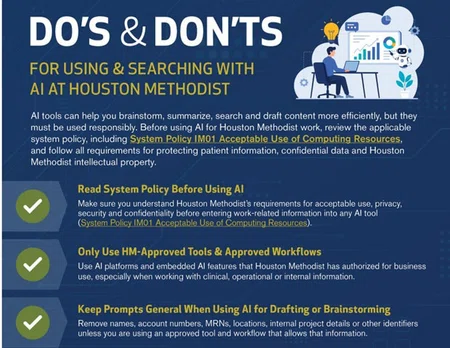
Do's and Don'ts for Using and Searching with AI at Houston Methodist
PRACTICE
CNREP Pilots Innovative Wound Care Copilot to Enhance Pressure Injury Assessment
Text-SAFE: A Digital Health Approach to Improving Follow-Up Care and Support After Sexual Assault
PROFESSIONAL DEVELOPMENT
Artificial Intelligence Education
Clinical Informatics Council: Empowering Nurses Through Technology
From Bedside to Informatics
MAGNET
FROM OUR TEAMS
ABOUT DISCOVERN


EDUCATION
Embracing Artificial Intelligence in Nursing Without Losing Our Humanity
By Lenis Sosa, DNP, RN, CCRC - Manager Clinical Education - Houston Methodist Clear Lake Hospital

Healthcare is experiencing one of the most significant technological transformations in its history. Artificial intelligence (AI), predictive analytics, virtual monitoring, automated documentation and smart clinical decision support tools are rapidly becoming part of everyday nursing practice. These innovations can improve efficiency, enhance patient safety and streamline workflows. However, as we embrace these advancements, we must remember a fundamental truth: technology should support nursing practice, not replace its essence.
Nursing has always been more than a profession. It is a calling built on compassion, human connection, critical thinking and advocacy for the vulnerable. No matter how advanced technology becomes, it cannot replicate the reassuring touch of a nurse holding a patient's hand, the empathy conveyed through a caring conversation or the clinical judgment developed through years of experience and practice.
The true value of AI in nursing lies in reducing administrative burdens and giving nurses more time to care for patients. Today, nurses spend much of their shifts documenting care, searching for information and managing complex workflows. AI-powered tools can automate routine tasks, summarize patient information, identify trends and deliver clinical insights more efficiently. When used appropriately, these technologies can free nurses to spend more meaningful time at the bedside.
However, we must be careful not to become overly dependent on technology. AI should never replace critical thinking or clinical judgment. Algorithms can analyze data and suggest recommendations, but they cannot fully understand an individual patient's unique circumstances, emotions, values and preferences. Nurses must continue to evaluate information critically and make decisions based on both evidence and the human context of care.
Patients come to our hospitals during some of the most challenging moments of their lives. They are often scared, vulnerable and uncertain about their future. In these moments, what they need most is not another piece of technology. They need a compassionate healthcare professional who listens, understands and provides reassurance. They need someone who sees them not as a diagnosis or a data point, but as a human being.
As nursing leaders, educators and clinicians, we have a responsibility to ensure that technological innovation aligns with our professional values. We must embrace tools that improve care delivery while safeguarding the human aspects of healthcare. Success should not be measured by the amount of technology we implement, but by how effectively we use it to enhance patient care and strengthen nurse-patient relationships.
The future of nursing is not a choice between technology and compassion. The future lies in combining the best of both. AI can help us work smarter, but our humanity is what makes nursing exceptional. Compassion, empathy, advocacy and critical thinking remain irreplaceable. Technology can process information, but only nurses can deliver healing through human connection.
As we move forward in this era of innovation, let us ensure that technology serves as a tool that empowers nurses rather than distracts from our mission. By integrating AI thoughtfully into practice, we can improve efficiency, support clinical decision making and spend more time where we are needed most: at the patient's bedside, providing compassionate, person-centered care.
The future of healthcare may be digital, but the heart of nursing will always be human. Let us carry that truth forward as we embrace innovation and protect the compassion that defines our profession.