© 2025. Houston Methodist, Houston, TX. All rights reserved.





In this
issue

WELCOME
NURSING SCIENCE


Nursing Science and Sustainable Nursing Practice: Reimaging the Future of Care
Article Review: The environmental awareness of nurses as environmentally sustainable health care leaders: a mixed method analysis
EDUCATION
Enhancing Hospital Supply Efficiency and Cost Savings Through Lean 5S Methodology
From Kaizen to Care: Building Sustainable Change at Houston Methodist Clear Lake
Transforming Supply Room Efficiency in Labor and Delivery: Utilizing Lean and A3 Problem Solving
PRACTICE
BMAT for Acute Care HMCL - Kaizen Project
Green ICU Initiative: Building a Sustainable Critical Care Environment
Sustaining the Nursing Workforce Through Residency Programs
PROFESSIONAL DEVELOPMENT
Empowering Nurses Through Mentorship: Building Resilience and Leadership from Within
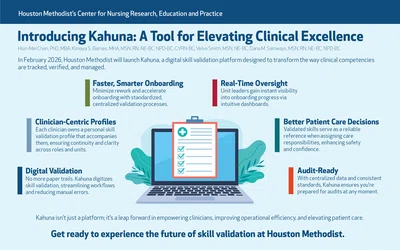
Introducing Kahuna: A Tool for Elevating Clinical Excellence
MAGNET
Professional Governance at Houston Methodist Baytown
Improving the Efficiency of Annual Critical Care Nursing Competencies by Incorporating High-Fidelity Simulation
FROM OUR TEAMS
ABOUT DISCOVERN


FROM OUR TEAMS
Strengthening Nursing Sustainability with Strategic Community Partnerships
By LaToya C. Clower, MSN, RN, CVRN-BC, MEDSURG-BC
Professional Development Leader, Houston Methodist Hospital
By LaToya C. Clower, MSN, RN, CVRN-BC, MEDSURG-BC
Professional Development Leader, Houston Methodist Hospital

Sustainability in health care refers to delivering care in ways that minimize environmental impact, enhance patient outcomes and ensure the long-term resilience of health care systems. Increasingly, it is viewed through a triple lens — encompassing environmental, social and financial principles — focused on minimizing harm to society (Wanyenze, 2023). This approach encompasses energy-saving strategies, supply chain optimization, waste reduction and other protocols that are now widely adopted in hospitals nationwide.
Cost-effective innovations, such as telemedicine and virtual monitoring, signal a shift toward more flexible and resource-efficient care models. Together, these efforts expand access to care and advance sustainability in nursing practice.
Professional growth and career development are crucial for sustaining a successful nursing practice. They give nurses the skills to adapt to changing health care demands. Whether through advanced education or specialty certification, these pathways are key to clinical excellence.
Wanyenze et al. (2023) emphasize that stakeholders should form partnerships with a purpose and engage in mutual learning. Houston Methodist Hospital has partnered with the University of St. Thomas (UST) to support low-income, first-generation college students pursuing careers in nursing with the Rising Stars program. Students join Houston Methodist in their sophomore year and begin the patient care assistant (PCA) pathway, which provides them with early clinical exposure and foundational experience.
In junior and senior years, students are paired with registered nurses across diverse hospital units. This hands-on mentorship strengthens clinical knowledge, builds accountability and encourages self-advocacy throughout their nursing journey.
This internship opens doors to multiple opportunities, from building core nursing skills as a PCA to advancing to the Methodist Advancement into Professional Practice (MAPP) program and Nursing Residency. It’s a pathway that supports students throughout their school years and sustains their growth well into their careers.
As students progress, they gain access to full-time roles, tuition reimbursement and advanced nursing degrees. This partnership does more than prepare students for a job — it launches them into a lifelong, rewarding career in nursing. The sky’s the limit!
Reference: