© 2025. Houston Methodist, Houston, TX. All rights reserved.





In this
issue

WELCOME
NURSING SCIENCE


Nursing Science and Sustainable Nursing Practice: Reimaging the Future of Care
Article Review: The environmental awareness of nurses as environmentally sustainable health care leaders: a mixed method analysis
EDUCATION
Enhancing Hospital Supply Efficiency and Cost Savings Through Lean 5S Methodology
From Kaizen to Care: Building Sustainable Change at Houston Methodist Clear Lake
Transforming Supply Room Efficiency in Labor and Delivery: Utilizing Lean and A3 Problem Solving
PRACTICE
BMAT for Acute Care HMCL - Kaizen Project
Green ICU Initiative: Building a Sustainable Critical Care Environment
Sustaining the Nursing Workforce Through Residency Programs
PROFESSIONAL DEVELOPMENT
Empowering Nurses Through Mentorship: Building Resilience and Leadership from Within
Introducing Kahuna: A Tool for Elevating Clinical Excellence
MAGNET
Professional Governance at Houston Methodist Baytown
Improving the Efficiency of Annual Critical Care Nursing Competencies by Incorporating High-Fidelity Simulation
FROM OUR TEAMS
ABOUT DISCOVERN


PRACTICE
Sustaining the Nursing Workforce Through Residency Programs

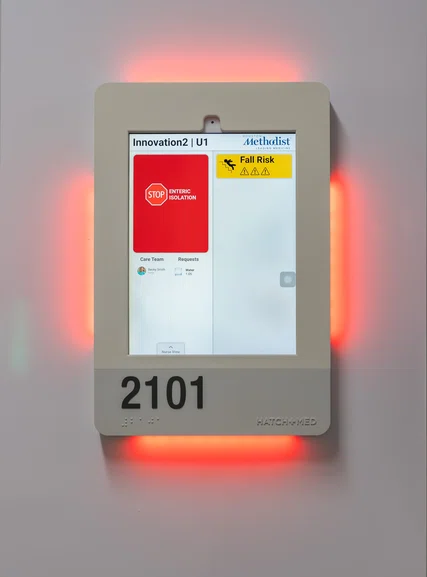
Moreover, these smart room technologies significantly streamline communication between nursing staff and other healthcare providers. They allow for quicker updates and alerts, ensuring everyone involved in a patient’s care is on the same page. As noted in the McKinsey survey, nurses’ workload often includes tasks that, when optimized, lead to increased efficiency and improved patient outcomes.
By adopting smart room technology, hospitals enhance their operational efficiency and contribute to a higher level of job satisfaction among nursing staff. When nurses can efficiently manage their tasks through technology, they experience reduced stress, increased job fulfillment and a more significant opportunity to connect meaningfully with their patients. This is particularly important in nursing, where strong patient-nurse relationships are integral to providing compassionate, effective care. At Houston Methodist West, pre-and post-implementation questionnaires will be included to evaluate staff perceptions of the Vibe Health smart room platform, explicitly focusing on time management and awareness of patients’ needs. Additionally, self-report questionnaires will be used to evaluate patients’ perceptions of the Vibe Health smart room platform, with questions addressing awareness of the care team, pain management and mobility goals.
Nurse Residency Program at Houston Methodist
By Jo-Anne Senneff, MSN, RN, CCRN, Professional Practice Leader and Ashley Tolbert, DNP, RN, FNP-C, Professional Development Leader, Houston Methodist Hospital
The transition from academia to clinical practice is challenging for newly licensed nurses (NLNs). In the first three to six months, many experience heightened stress and anxiety, often called reality shock. During this time, new graduates may feel overwhelmed and disillusioned, noticing gaps in the health care system and questioning their readiness. These feelings can manifest as self-doubt, perceived incompetence and frustration, often expressed as, “This isn’t what I thought it would be.” If unaddressed, this experience can lead to clinical errors, poor patient outcomes, disengagement, absenteeism and even leaving the profession (Stage, McNulty, LaMonica-Way, Senneff, 2022).
To address these challenges, a strong, supportive environment is essential. Houston Methodist meets this need through its Commission on Collegiate Nursing Education (CCNE)-accredited Nurse Residency Program (NRP). This program ensures that NLNs are never alone in their journey and receiving support at every stage of transition.
The mission of Houston Methodist’s NRP is to create a psychologically safe environment that promotes growth, development and leadership for NLNs. Through personal connections and innovative best practices, the program helps nurse residents build confidence and competence, supporting their progression from advanced beginners to proficient professionals.

In partnership with the Vizient/American Association of Colleges of Nursing (AACN) Nurse Residency Program™, Houston Methodist’s NRP delivers a comprehensive curriculum that supports both professional and personal sustainability. Professional development strategies are woven throughout, helping nurse residents establish a strong identity and develop a long-term commitment to nursing. The program also promotes lifelong learning and active involvement in professional organizations.
Equally important is personal well-being. The curriculum includes evidence-based content on stress management, compassion fatigue and burnout, taught by subject matter experts. These resources provide nurse residents with practical tools to maintain emotional resilience and overall well-being.
Collaboration across the organization — unit leaders, directors, managers, professional practice leaders and educators — is essential for a successful transition from academia to practice. This teamwork supports individual nurse growth and strengthens the long-term sustainability of the nursing workforce.
Reference:
TRAC Program: Strengthening the Nursing Workforce Through Sustainable Development
By Shedrick Kennedy, RN, CCRN, NPD-BC, Professional Development Leader, Houston Methodist Hospital
As healthcare systems face staffing shortages and growing patient complexity, sustainable workforce development is a top priority. The Transitional Residency for Acute Care (TRAC) program offers a strategic solution, helping experienced nurses transition into acute care while promoting retention and professional growth.
TRAC is a 14-week residency for registered nurses with at least one year of experience and a BSN who are new to inpatient hospital settings. Many participants come from skilled nursing facilities, outpatient clinics, or international backgrounds. Although experienced, they often lack exposure to the fast-paced demands of acute care. TRAC closes this gap with a blended educational model combining classroom instruction, simulation-based learning, and hands-on clinical practice.
TRAC stands out for its focus on mentorship and clinical assimilation. Nurses work 12-hour shifts with support from preceptors and Professional Practice Leaders, receiving real-time guidance and feedback. This approach builds confidence, speeds up competence, and encourages specialty certification—key factors in nurse retention.
Now in its fifth cohort, TRAC has shown itself to be a scalable model for workforce sustainability. It acknowledges that experienced nurses face transition challenges similar to those of new graduates and provides tailored support. By investing in these professionals, healthcare organizations fill staffing gaps and build resilient, skilled teams that are ready to meet the changing needs of patients.
At a time when retention and development are critical, TRAC offers an innovative approach to creating a stronger, more sustainable nursing workforce.