© 2025. Houston Methodist, Houston, TX. All rights reserved.





In this
issue

WELCOME
NURSING SCIENCE


Nursing Science and Sustainable Nursing Practice: Reimaging the Future of Care
Article Review: The environmental awareness of nurses as environmentally sustainable health care leaders: a mixed method analysis
EDUCATION
Enhancing Hospital Supply Efficiency and Cost Savings Through Lean 5S Methodology
From Kaizen to Care: Building Sustainable Change at Houston Methodist Clear Lake
Transforming Supply Room Efficiency in Labor and Delivery: Utilizing Lean and A3 Problem Solving
PRACTICE
BMAT for Acute Care HMCL - Kaizen Project
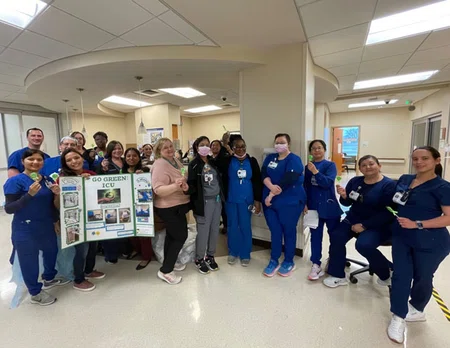
Green ICU Initiative: Building a Sustainable Critical Care Environment
Sustaining the Nursing Workforce Through Residency Programs
PROFESSIONAL DEVELOPMENT
Empowering Nurses Through Mentorship: Building Resilience and Leadership from Within
Introducing Kahuna: A Tool for Elevating Clinical Excellence
MAGNET
Professional Governance at Houston Methodist Baytown
Improving the Efficiency of Annual Critical Care Nursing Competencies by Incorporating High-Fidelity Simulation
FROM OUR TEAMS
ABOUT DISCOVERN


NURSING SCIENCE
Nursing Science and Sustainable Nursing Practice: Reimaging the Future of Care
Kiara Whitney, DNP, APRN, FNP-C, AGACNP-BC, EBP-CH, Nurse Scientist, Houston Methodist Hospital
Kiara Whitney, DNP, APRN, FNP-C, AGACNP-BC, EBP-CH, Nurse Scientist, Houston Methodist Hospital

The Evolving Landscape of Health Care
The health care landscape is rapidly evolving. Progress accelerates at a pace once unimaginable, driven by new technologies, treatments, and the expansion of knowledge frontiers. Yet beneath this brilliance lies a critical question: can we sustain the people and systems that make progress possible? Nurses stand at the center of this paradox as drivers of progress and guardians of endurance. Our work bridges science and humanity; data and healing; and innovation and purpose. Nursing science offers a way forward, turning knowledge into resilience and practice into sustainability. The next evolution of health care depends on how well nursing weaves sustainability into innovation — ensuring progress never comes at the expense of those who deliver it.
Redefining Sustainability Through Nursing Science
Sustainability in nursing goes far beyond environmental conservation. It reflects the ability of health care organizations, schools and practitioners to maintain excellence while protecting the vitality of caregivers and optimizing work structures. A sustainable workforce must be intentionally designed, not reactively maintained. Chiou (2025) emphasizes that rebuilding sustainability requires ecosystems promoting adaptability, mentorship and purpose-driven leadership. These elements turn the workforce into a learning organization capable of renewal rather than burnout. Chiou also reframes sustainability as not just retention but also vitality — a living process shaped by empowerment, equity and education.
At its core, sustainable nursing practice involves striking a balance between progress and preservation. The profession’s responsibility is to innovate continuously while ensuring that innovation does not exhaust the very people who sustain it. Shaban et al. (2024) describe sustainability as an ethical standard that is woven into the nursing identity. When stewardship of human and environmental resources becomes part of the nursing role, it boosts engagement, moral satisfaction and alignment with organizational values. Sustainability is where ethics, efficiency and endurance meet, making it an ethical framework as much as an operational one.
Operational sustainability requires system-level design. Molero et al. (2021) argue that true sustainability happens when precision, resource optimization and innovation work in harmony. Although their analysis focuses on laboratory medicine, the principles also apply to nursing. It shows that efficiency and sustainability are not opposites but rather reinforce each other when guided by evidence-based system design. Clinical excellence depends on innovative structures that eliminate redundancy, integrate technology thoughtfully and prioritize human capability over sheer volume.
Building Capacity Through Knowledge, Education and Leadership
Nursing science turns sustainability from an idea into practical, actionable knowledge. Through implementation research, data analysis, and translational frameworks, nurse scientists investigate how evidence-based innovations transition from pilot projects to become integrated into everyday practice. Ten Ham-Baloyi (2022) showed that nurses who lead practice changes not only improve patient outcomes but also build organizations that learn and adapt continuously. Her findings emphasize that sustainability happens when applying evidence becomes a routine habit rather than a one-time effort.
Education is the engine that powers sustainable practice. Nursing curricula must go beyond technical skills to develop professionals who think systemically, interpret evidence, design solutions and influence policy. Empowering nurses to lead change through evidence-based practice is not just an academic goal — it’s a strategic necessity. Ten Ham-Baloyi (2022) notes that giving nurses the knowledge and confidence to apply evidence strengthens their role as transformational leaders, ensuring innovation lasts. This empowerment creates a ripple effect across care systems, building a culture where progress is driven by evidence, guided by inquiry and rooted in excellence. Academic–practice partnerships are key to turning these principles into measurable improvements, producing nurses who are not only skilled clinicians but also system stewards.
Leadership is the anchor for sustainability. Chiou (2025) identifies equity, adaptability and mentorship as essential traits of sustainable leaders that are linked to workforce stability, trust and engagement. Leaders who promote psychological safety, inclusivity and purpose make sustainability a cultural norm, not just a compliance task. They understand that maintaining high-quality care means supporting caregivers, integrating well-being and professional growth into the organization’s foundation.
Global and Environmental Imperatives for Sustainability
Nursing sustainability is deeply tied to the global context. The International Council of Nurses (2025) warns that without intentional reform, workforce instability could undermine health systems worldwide. Their survey of nursing leaders highlighted common concerns, including aging demographics, unsafe workloads and inadequate policy support, all of which are clear signs that the sustainability challenge is systemic and global. Solving these issues demands coordinated investment in education, workforce planning and policies that treat nursing as essential health infrastructure.
Sustainability also encompasses the environments where care is provided. Corvalán et al. (2020) emphasize that health systems must be resilient to ecological disruptions and social pressures. Climate-resilient, environmentally responsible facilities are no longer optional — they are essential for health equity and long-term viability. Their research confirms that environmental stewardship, workforce well-being and operational efficiency are interconnected pillars of sustainable health care.
Conclusion: Sustainability as a Moral and Scientific Imperative
Nursing science provides structure for progress, while sustainable practice gives it life. Together, they define a profession committed not only to caring but to enduring. Every project, mentorship and innovation adds to a legacy that lasts beyond a single shift or season. The sustainability of health care depends on how intentionally we support those who make care possible.
Sustainable nursing practice represents a shift from managing the urgent to safeguarding the essential. It reminds us that excellence should never come at the expense of caregivers. Through nursing science, sustainability becomes both a professional responsibility and a moral promise — a commitment to protect the people, the purpose and the future of nursing.
References:
Chiou, P. Y. (2025). Rebuilding a sustainable nursing workforce: From evidence to action. The Journal of Nursing Research, 33(5), e408. https://doi.org/10.1097/jnr.0000000000000709
Corvalán, C., Villalobos Prats, E., Sena, A., et al. (2020). Towards climate resilient and environmentally sustainable health care facilities. International Journal of Environmental Research and Public Health, 17(23), 8849. https://doi.org/10.3390/ijerph17238849
International Council of Nurses (ICN). (2025). Assessing the global sustainability of the nursing workforce: A survey of national nurses’ association presidents.
Molero, A., Calabrò, M., Vignes, M., Gouget, B., & Gruson, D. (2021). Sustainability in healthcare: Perspectives and reflections regarding laboratory medicine. Annals of Laboratory Medicine, 41(2), 139–144. https://doi.org/10.3343/alm.2021.41.2.139
Shaban, M. M., Alanazi, M. A., Mohammed, H. H., Mohamed Amer, F. G., Elsayed, H. H., Zaky, M. E., Ramadan, O. M. E., Abdelgawad, M. E., & Shaban, M. (2024). Advancing sustainable healthcare: A concept analysis of eco-conscious nursing practices. BMC Nursing, 23(1), 660. https://doi.org/10.1186/s12912-024-02197-0
Ten Ham-Baloyi, W. (2022). Nurses’ roles in changing practice through implementing best practices: A systematic review. Health SA = SA Gesondheid, 27, 1776. https://doi.org/10.4102/hsag.v27i0.1776